
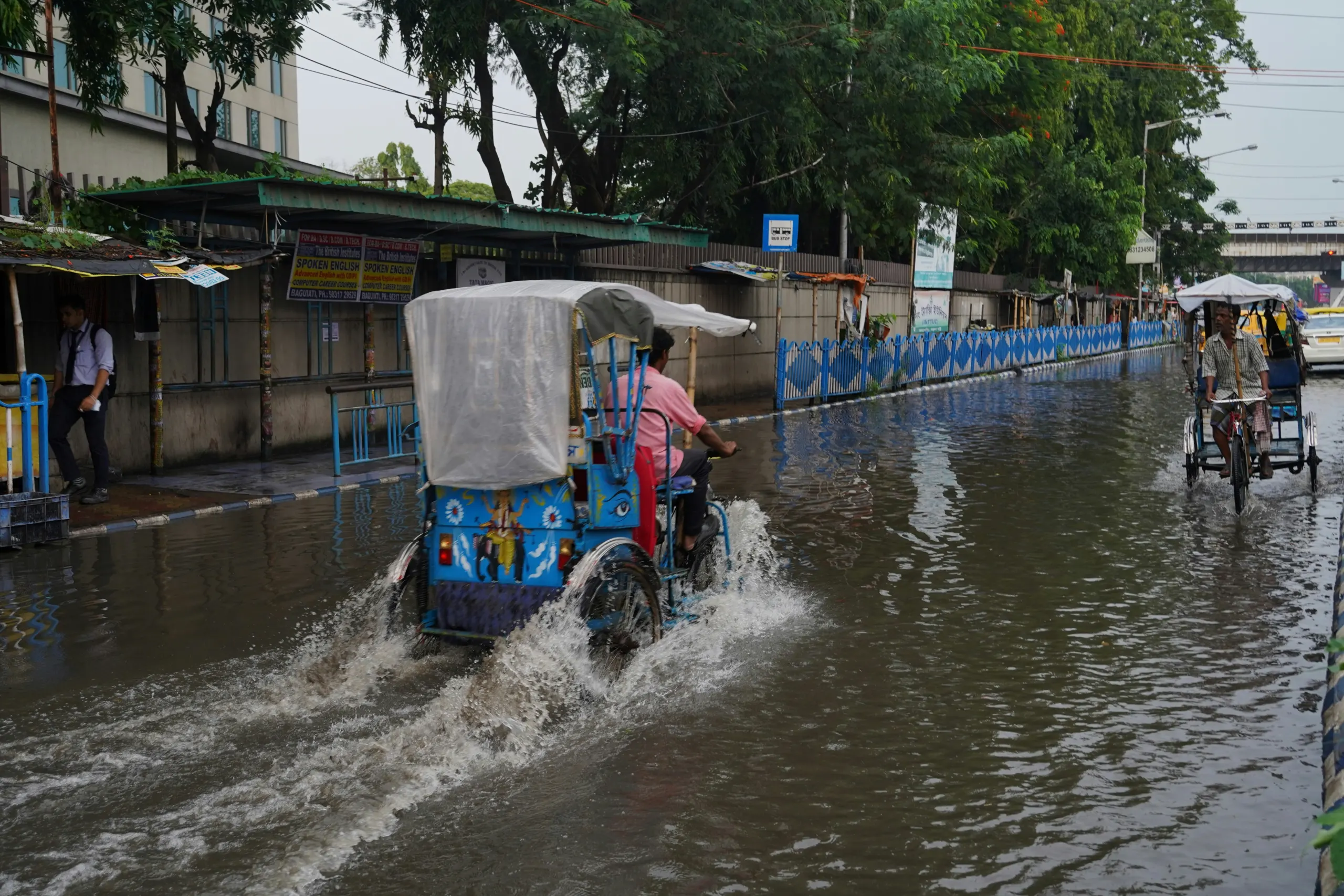
Despite forecasts of below-average rainfall, the 2026 South Asian monsoon has brought severe flooding across India, Bangladesh and Pakistan. In this article, JBA Climate Scientist Dr Jack Giddings explores the drivers behind the season and what it reveals about flood risk, preparedness and resilience.
Ready to discuss your next project? Contact our team today.
The South Asian monsoon is a lifeline for billions of people, supporting agriculture, water resources and livelihoods. It is also one of the region’s most significant drivers of flood risk. In 2026, seasonal forecasts predicted below-average rainfall across South Asia, partly linked to the rapid development of a “super” El Niño in the central and eastern Pacific Ocean. But as the season has progressed, damaging local extremes have still occurred, with flash floods and landslides affecting communities across India, Pakistan and Bangladesh.
The southwest monsoon arrived over Kerala, India, on 4 June, three days later than the climatological average. Its subsequent progression was slow, and June was unusually dry nationwide, with rainfall around 33% below the long-period average (Global Agriculture, 2026).
Yet a dry start did not mean an absence of flood risk. Instead, the season has been characterised by sharp contrasts in rainfall, with some districts continuing to report deficits while others experienced intense, localised rainfall and flooding.
Kerala provides an early example of heavy, localised rainfall accompanying the monsoon’s arrival. Up to 260 mm of rain fell along parts of the western coast over three days, contributing to flash flooding and a deadly landslide in the district of Wayanad (Mongabay, 2026). Despite the floods, by 24 June Kerala remained 32% below its normal seasonal rainfall (India Today, 2026).
The regional contrast in rainfall continued through July as the monsoon trough became more active across northern and western India. The monsoon trough is a zone of low pressure that triggers and organises convective rainfall. Together with mountainous terrain, this circulation can lift warm, moist air from the Arabian Sea and Bay of Bengal, generating intense, localised thunderstorms.
In Gujarat, Umergam in Valsad district recorded 1,064 mm of rain in 24 hours on 23 July – the third-highest daily rainfall total ever recorded in India (Figure 1; IMD, 2026; Hindustan Times, 2026). More than 42,000 people were evacuated as rivers overflowed and drainage systems in cities such as Surat and Ahmedabad struggled to cope with the exceptional rainfall (The New Indian Express, 2026).
Northeast India also experienced severe impacts. Intense rainfall across the Brahmaputra basin through July and August caused widespread flooding in Assam and Nagaland, where more than 100 people have died during the season and more than 700,000 have been displaced (Associated Press, 2026).
Together, these events show how the uneven distribution of monsoon rainfall can still produce serious flood impacts. They also underline the need for forecasting, preparedness and longer-term planning that reflect local patterns of exposure and risk.
Figure 1: Animation of rainfall across South Asia from 18 July to 29 July 2026. Rainfall data source: NASA GPM 3-hourly rainfall accumulation (2026). Additional data sources: GLOBE Task Team et al. (1999), Linke et al. (2019) and Lehner et al. (2022).
The impacts have extended well beyond India. In Bangladesh, heavy monsoon rainfall caused flash flooding and landslides across eastern and northeastern districts during July. Satellite-derived rainfall estimates indicate more than 600 mm of rain fell over a 7-day period across southeastern parts of the country, with accumulations of around 400 mm across northern regions (Figure 2).
By 12 July, more than 1.1 million people across ten districts had been affected and 51 deaths had been reported. More than 38,000 people were staying in evacuation shelters, while damage to roads, water systems and other infrastructure complicated humanitarian access (United Nations Bangladesh, 2026).
Pakistan has also experienced successive intense rainfall events since late June. Flash flooding and landslides have affected several regions, particularly Khyber Pakhtunkhwa and Punjab. By late July, national authorities had reported more than 100 deaths, alongside damage to homes and infrastructure (Government of Pakistan, 2026).
These events demonstrate the catchment-wide nature of monsoon flood risk. Heavy rainfall in upstream locations, including parts of India and the wider Ganges–Brahmaputra–Meghna system, can contribute to rapidly changing river conditions downstream. Communities may also face several interacting hazards during the monsoon season, from river and flash flooding to landslides and urban flooding.
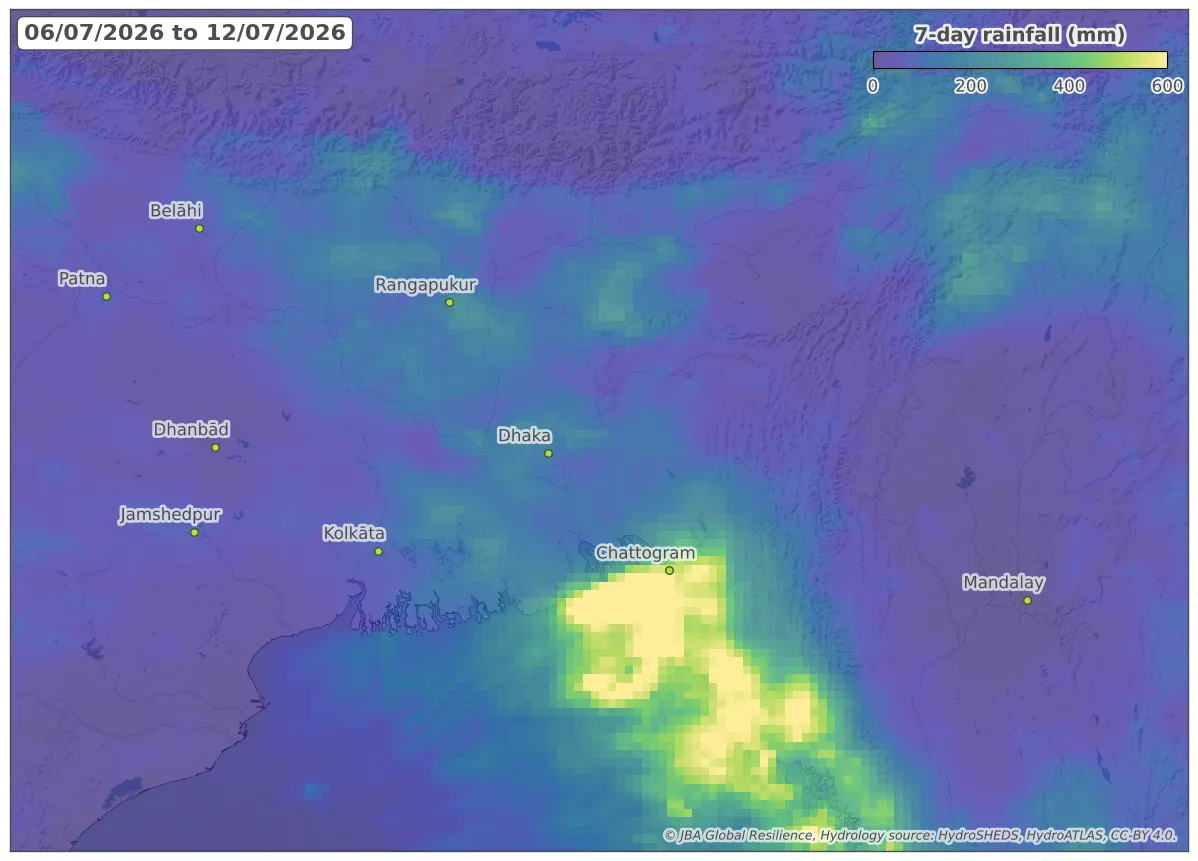
Figure 2: 7-day rainfall accumulation across Bangladesh from 6 July to 12 July 2026. Rainfall data source: NASA GPM IMERG 7-day rainfall accumulation (2026). Additional data sources: GLOBE Task Team et al. (1999), Linke et al. (2019) and Lehner et al. (2022).
The South Asian monsoon varies considerably from year to year and within each season. This variability is influenced by several interacting large-scale oceanic and atmospheric processes.
One important driver in 2026 is El Niño. The tropical Pacific transitioned from neutral conditions towards El Niño during spring, and the World Meteorological Organization (WMO) reported in September that El Niño was firmly established and expected to intensify into a very strong event that will likely persist through to February 2027 (WMO, 2026).
El Niño is often associated with a weaker summer monsoon, increasing the likelihood of below-average seasonal rainfall over parts of South Asia. However, this relationship is neither simple nor uniform. Since 1950, seven out of the 16 El Niño years resulted in below-average rainfall over India (Government of India, 2026).
A weaker monsoon also does not prevent extreme rainfall. Research suggests that El Niño can intensify extreme daily rainfall over parts of southwestern and central-eastern India. Although this pattern is broadly consistent with the 2026 monsoon, attribution analysis would be needed to determine whether El Niño influenced this season’s rainfall variability (UNDRR, 2026).
Other large-scale climate drivers can reinforce or counteract El Niño’s influence, including the Indian Ocean Dipole (IOD). The IOD describes differences in sea surface temperature across the tropical Indian Ocean and can modify monsoon circulation. A positive IOD can counteract the drying influence of El Niño over South Asia. During the July floods, the IOD remained neutral, suggesting it was not a major large-scale driver of the intense rainfall observed (NICES, 2026).
Large-scale climate drivers such as El Niño and the IOD may influence the seasonal forecast, but the timing, location and intensity of localised rainfall events depend on weather systems operating over much shorter timescales.
For the humanitarian and disaster risk reduction sectors, the 2026 season reinforces an important point that largely below-average seasonal rainfall across South Asia does not necessarily mean below-average flood risk.
Preparedness therefore needs to work across varying temporal and spatial scales. Seasonal forecasts can help identify changing background conditions months ahead across multiple countries, while shorter range forecasts progressively refine where hazardous rainfall may occur in specific regions. Flood forecasting can then translate rainfall and river conditions into information about where communities, infrastructure and livelihoods are most likely to be affected.
Alongside forecasting, longer-term risk reduction remains essential. Better flood-risk mapping, impact-based early warning, resilient infrastructure, protection and restoration of natural floodplains, evacuation planning and anticipatory risk financing can all reduce the human consequences of extreme monsoon rainfall.
The 2026 monsoon is not over. With large-scale climate drivers such as El Niño and IOD continuing to evolve, uncertainty remains over the changing rainfall patterns during the remainder of the season.
What the season has already shown is that rainfall totals alone tell only part of the story. A season can be relatively dry overall while still producing exceptional rainfall, destructive floods and major humanitarian impacts in individual catchments.
Understanding that variability – from large-scale climate drivers to local flood behaviour – is central to building resilience. Combining climate science, flood modelling, forecasting and locally grounded preparedness can give decision-makers more time and better information to act before an extreme rainfall event becomes a disaster.
Associated Press, 2026. Flood death toll in India’s Assam reaches 100 as thousands lose their homes. [Online]. Available here. [Accessed 20 August 2026].
Global Agriculture, 2026. India Reports 33% Rainfall Deficit in June Amid El Niño; Monsoon Improves in July. [Online]. Available here, [Accessed 22 July 2026].
GLOBE Task Team, 1999. The Global Land One-kilometer Base Elevation (GLOBE) Digital Elevation Model, Version 1.0. [Online]. Available here. [Accessed 5 December 2025].
Government of India, 2026. Parliament Question: El Niño effect on monsoon and rainfall. [Online]. Available here. [Accessed 2 September 2026].
Government of Pakistan, 2026. PR No. 259 Emergency response committee holds 6th meeting to review monsoon preparedness and ongoing response. [Online]. Available here. [Accessed 20 August 2026].
Hindustan Times, 2026. Umergam records third highest 24-hr rain ever recorded in India. [Online]. Available here. [Accessed 30 July 2026].
India Meteorological Department (IMD), 2026. Press Release from the Government of India, Ministry of Earth Sciences, India Meteorological Department. [Online]. Available here. [Accessed 30 July 2026].
India Today, 2026. Monsoon hit Kerala on June 4, but state still faces 32% rain deficit: What’s wrong? [Online]. Available here. [Accessed 20 August 2026].
Lehner, B., Messager, M. L., Korver, M. C., Linke, S., 2022. Global hydro-environmental lake characteristics at high spatial resolution. Scientific Data 9: 351. https://doi.org/10.1038/s41597-022-01425-z
Linke, S., Lehner, B., Ouellet Dallaire, C., Ariwi, J., Grill, G., Anand, M., Beames, P., Burchard‑Levine, V., Maxwell, S., Moidu, H., Tan, F., Thieme, M., 2019. Global hydro‑environmental sub‑basin and river reach characteristics at high spatial resolution. Scientific Data 6: 283. https://doi.org/10.1038/s41597-019-0300-6
Mongabay, 2026. Tunnel landslide raises fresh questions over mountain development. [Online]. Available here. [Accessed 20 August 2026].
NASA Global Precipitation Measurement (NASA GPM), 2026. Precipitation Data Directory. [Online]. Available here. [Accessed 26 August 2026].
National Information System for Climate and Environment Studies (NICES), 2026. Current Status of ENSO and IOD Impacts on the Indian Summer Monsoon. [Online]. Available here. [Accessed 25 August 2026].
The New Indian Express, 2026. Gujarat battles statewide flood crisis as over 40,500 evacuated; death toll rises. [Online]. Available here. [Accessed 30 July 2026].
UNDRR, 2026. A ‘super El Niño’ could make India’s monsoon drier yet more dangerous. [Online]. Available here. [Accessed 2 September 2026].
United Nations Bangladesh, 2026. Bangladesh: Situation Report #1 – Flash Flood and Landslides (13 July 2026). [Online]. Available here. [Accessed 20 August 2026].
World Meteorological Organization (WMO), 2026. El Niño set to become very strong, raising risks of extreme weather into 2027. [Online]. Available here. [Accessed 3 September 2026].
Ready to discuss your next project? Contact our team today.
Discover more about the challenges and solutions shaping resilience and sustainable development across the globe.