
Anticipatory action helps organisations use forecasts and risk information to act earlier, before the most severe impacts of a hazard occur. Explore the key steps, from understanding risk and setting triggers to planning, financing and taking early action.
Ready to discuss your next project? Contact our team today.
Floods, droughts and other hazards can have widespread impacts on people, infrastructure, livelihoods and essential services. Advances in forecasting, monitoring and risk analysis mean organisations often have valuable information before the most severe impacts occur.
Anticipatory action uses this information to take pre-agreed actions before significant impacts occur. Rather than deciding what to do during a crisis, organisations agree in advance what actions will be taken when specific conditions are forecast.
There is often a window of opportunity between identifying an emerging hazard and experiencing its full impacts. During this period, organisations may still have time to protect assets, prepare critical infrastructure, mobilise resources, support vulnerable communities and activate emergency arrangements before conditions worsen.
Acting during this decision-making window can reduce impacts and disruption and, in some contexts, lower the cost of assistance compared with responding after conditions have worsened. Anticipatory action helps organisations make better use of the time and information available (FAO and WFP, 2025).
Anticipatory action connects long-term preparedness with emergency response. Preparedness activities, such as risk assessment, planning, training and capacity building, take place before a specific event is forecast. Emergency response and recovery begin once impacts occur.
Anticipatory action sits between these stages. It focuses on using forecasts and risk information once a potential hazard has been identified, but before significant impacts are experienced.
By linking preparedness planning with timely, forecast-informed decisions, organisations can move more confidently from understanding risk to taking action.
Every programme is different, but most anticipatory action systems bring together risk analysis, forecasts, trigger systems, agreed plans, financing and learning.
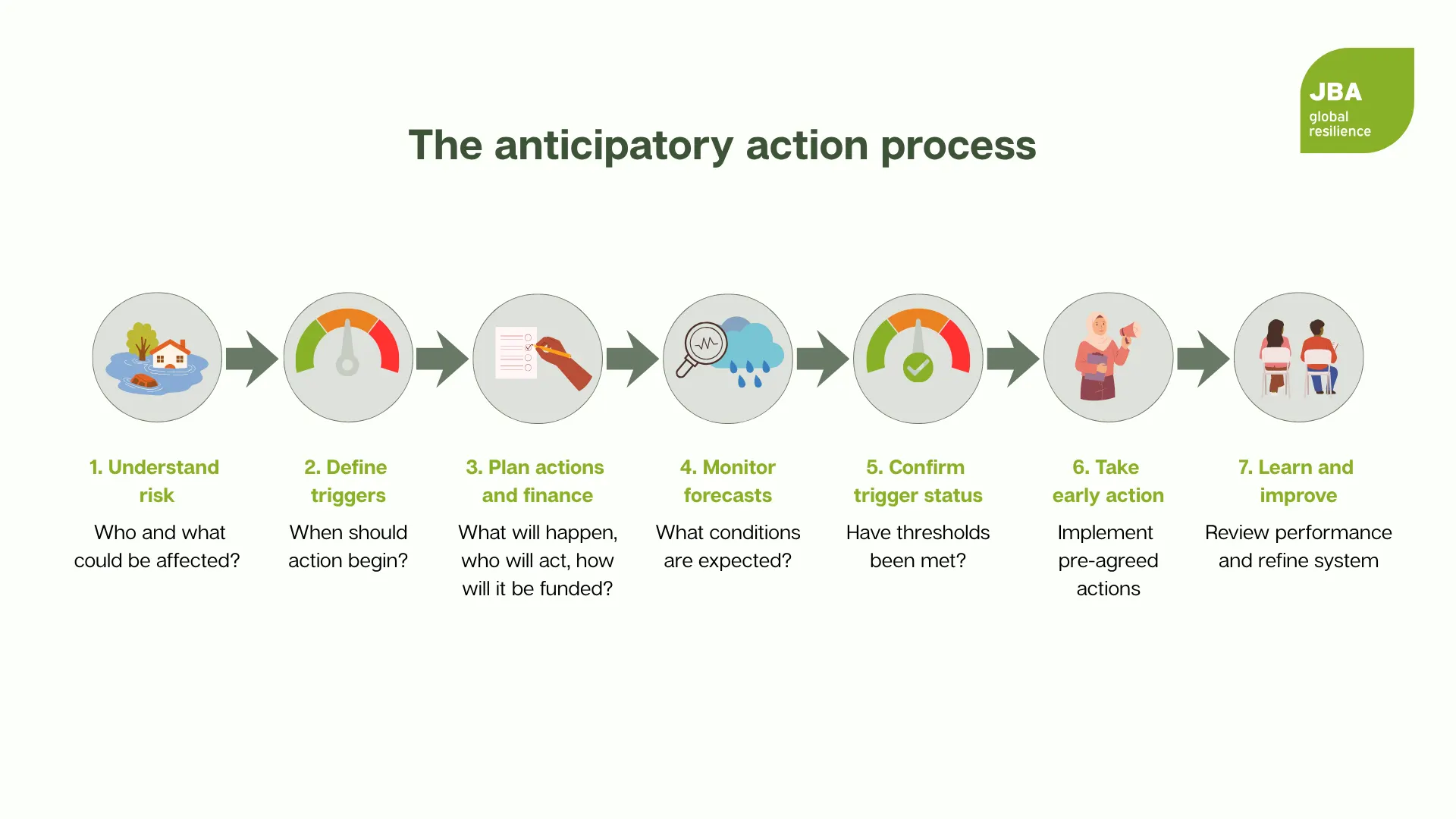
The first step is understanding where impacts are most likely to occur and who or what may be affected. This involves combining hazard information with data on people, infrastructure, agriculture, health services or other exposed assets. Understanding potential impacts in advance helps organisations prioritise where early action is likely to deliver the greatest benefit.
Anticipatory action depends on clear, pre-agreed trigger mechanisms. A trigger is a pre-defined condition that indicates when specific actions should begin. Triggers may be based on parameters such as forecast rainfall, river levels, drought indicators or estimates of likely impacts.
Developing triggers involves selecting the hazard conditions, indicators or impact thresholds that should prompt action, testing how well those trigger points perform, and harmonising definitions where multiple systems or partners are involved. It also requires agreeing what level of risk is sufficient to justify acting.
Trigger mechanisms only have value if they are linked to clear operational plans.
Organisations agree in advance what actions could be taken, who will make decisions, what resources are required and how funding will be released when trigger conditions are met. These pre-agreed arrangements enable organisations to act quickly rather than deciding what to do during an emergency.
Training and simulation exercises help everyone understand the process before an event occurs. They clarify roles, decision-making responsibilities and the steps to follow when trigger conditions are met, so partners are ready to act within the available window.
Forecasts provide information about the likelihood, timing and potential severity of future conditions.
Depending on the hazard and location, organisations may use national forecasting services, local observations, hydrological models, satellite data or global forecast systems. This information can be combined with exposure information to estimate likely impacts and support alerts, notifications and decision-making.
As forecast conditions change, organisations need a clear way to confirm whether trigger conditions have been met.
In some systems, this may involve independent operation and verification by a calculation agent. This provides a transparent and independent basis for activating pre-agreed actions or triggering release of anticipatory finance.
When trigger conditions are met, organisations can initiate pre-agreed actions. Depending on the hazard and context, these actions may include:
Pre-arranged funding is a critical part of many anticipatory action systems. Without agreed financing arrangements, organisations may recognise that impacts are likely but still be unable to act before conditions worsen. Linking funding mechanisms to agreed trigger conditions helps turn forecast information into timely operational decisions.
After each season or event, organisations review how forecasts, triggers, actions and financing arrangements performed.
This helps refine trigger thresholds, improve decision-making processes and strengthen future anticipatory action systems. As forecasting capabilities, local knowledge and operational experience grow, programmes can continue to improve over time.
All forecasts involve some uncertainty. Anticipatory action recognises this by using trigger levels that balance the benefits of acting early against the possibility that forecast conditions may not fully develop. These levels are designed using evidence, experience and local knowledge so that organisations can make informed decisions despite uncertainty.
As forecasting skill improves and more operational experience is gained, trigger thresholds can be refined to support increasingly effective decision-making.
Forecasts alone do not reduce risk. Their value comes from linking risk information to agreed triggers, plans and resources, so organisations can act before significant impacts occur.
By making decisions in advance and using the time available as a hazard develops, anticipatory action can help reduce disruption, protect people and assets, and support a faster and more effective response.
Food and Agriculture Organization of the United Nations and World Food Programme (2025), Saving lives, time and money: Evidence from anticipatory action. Available online here.
Ready to discuss your next project? Contact our team today.
Discover more about the challenges and solutions shaping resilience and sustainable development across the globe.