
Trigger-based disaster financing can provide faster, more predictable funding. Here, Louisa Whitlock, Disaster Risk Financing Specialist at JBA Global Resilience, explores why building confidence requires more than robust models.
Ready to discuss your next project? Contact our team today.
Despite years of investment and advocacy by governments, development partners and humanitarian organisations, disaster response remains largely financed in a reactive manner. When a major event overwhelms national resources, funding appeals are launched and assistance is mobilised. Yet by the time funding reaches affected communities, families may have lost homes, crops or livelihoods, while opportunities for early action have passed.
Disaster risk financing (DRF) seeks to address this problem by planning in advance how the financial costs of disasters will be managed. Pre-arranged financing for disasters is a central part of this approach. It involves funding approved before a crisis, with a commitment to release it when agreed conditions are met. These arrangements can make funds available to governments and humanitarian organisations before or shortly after disaster impacts occur, supporting anticipatory action or rapid response. Some instruments also transfer part of the financial risk of disasters to insurers and investors, giving decision makers the confidence that resources will be available when they are needed most.
However, pre-arranged financing accounted for just 1.2% of total crisis financing in 2023. Increasing uptake will depend in part on building confidence among governments, humanitarian actors and communities who expect to rely on it. That confidence depends on a simple question: when a disaster hits, will the expected funds arrive?
To make funding rapidly available to disaster risk managers, many pre-arranged financing instruments rely on funding being released when predefined triggers are met. The aim is to replace subjective decisions or lengthy damage assessments with an objective process that can release funds quickly when they are needed. Trigger-based approaches include forecast-based triggers which release funds allowing organisations to take anticipatory action before impacts occur, and parametric insurance, where an insurance policy pays out when a pre-agreed index reaches an agreed threshold.
Defining triggers and setting trigger thresholds is not always straightforward. Consider a flood insurance policy that pays out when a river reaches a certain depth at a particular location. To price the policy, insurers need to understand how often this threshold is likely to be reached.
However, water level is only a proxy for what ultimately matters to disaster managers: the impacts of flooding on people, assets, and livelihoods. Establishing a trigger threshold requires an understanding of how well the chosen indicator relates to these impacts. This can be challenging when historical records are limited, or where flooding occurs via different processes. For example, a community may be affected by surface water flooding following intense rainfall even when river levels remain below the trigger threshold.
To address this challenge, technical specialists combine historical data and stochastic risk modelling to estimate the likelihood of different events and their potential impacts. This allows them to identify indices that can be measured consistently and reliably, such as rainfall, river levels or flood extent, and determine the thresholds that are most appropriate for releasing funds. These models provide the evidence needed for insurers and investors to design and price disaster risk financing instruments.
Disasters often unfold in unexpected ways, and no model can capture reality perfectly. Trigger mechanisms are developed using incomplete data and assumptions about how hazards translate into impacts that can introduce uncertainty. As a result, there will sometimes be a mismatch between what the model indicates and what communities experience on the ground. This is known as basis risk. A financial instrument may fail to pay out despite significant impacts on the ground, or it may trigger even though losses are relatively limited. Neither outcome is desirable.
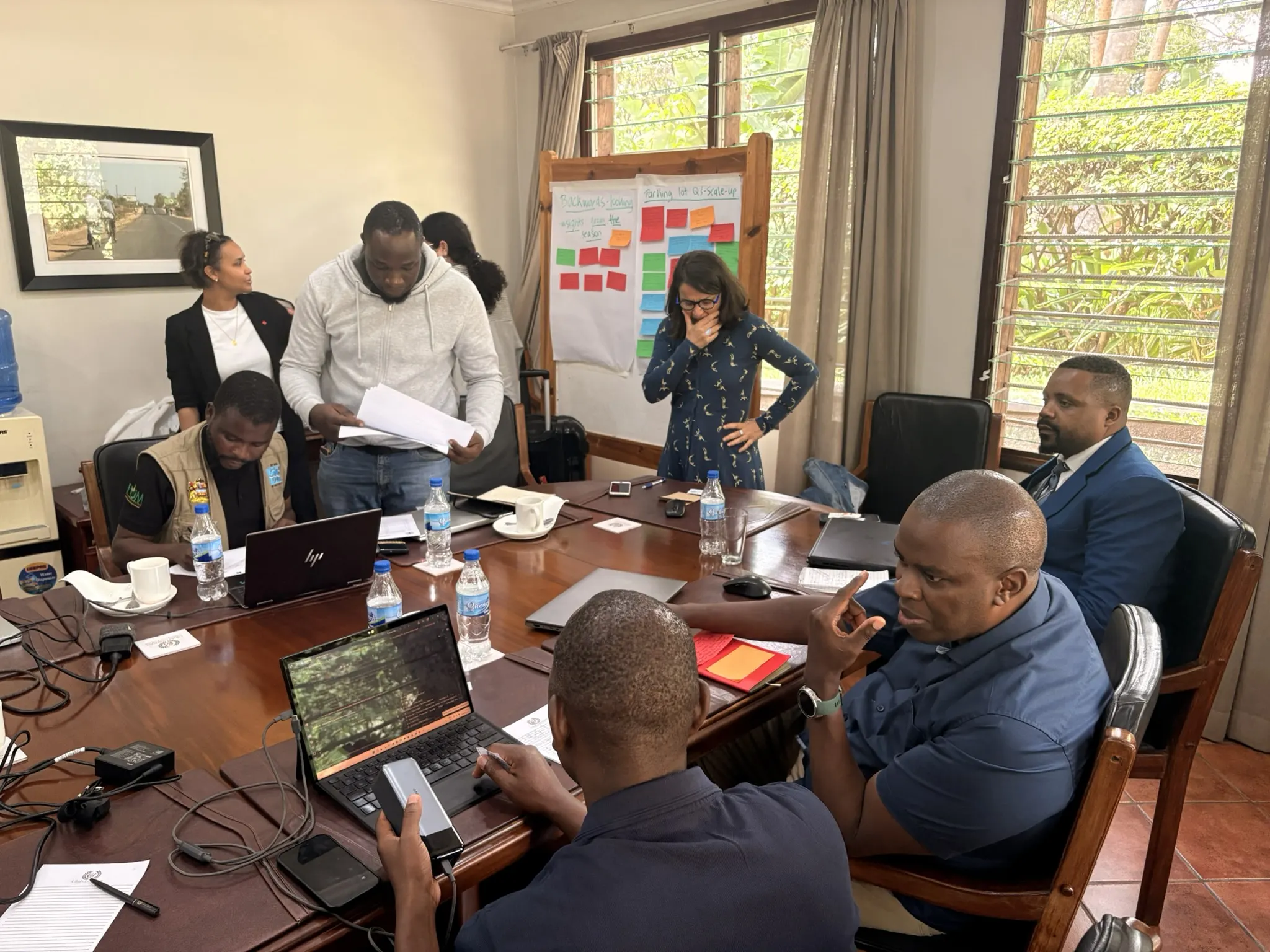
Stakeholders working together on trigger design for disaster risk financing in Malawi.
While basis risk is often discussed as a technical issue, it is equally a question of trust. Recent work by the Centre for Disaster Protection exploring government experiences of pre-arranged financing in Africa and the Caribbean highlights an important lesson: a trigger may be technically robust but that will not necessarily mean that stakeholders will have confidence in the outcomes it produces. A lack of confidence in trigger performance is a major factor hindering uptake of trigger-based DRF instruments.
Building confidence requires looking beyond model performance and the financial structuring of an instrument. Government agencies and humanitarian organisations must also consider how trigger mechanisms will be understood and perceived by stakeholders. They need confidence that they can explain why a trigger exists, how it was developed, and why a payout was or was not made.
This becomes particularly important when a damaging event does not result in a payout. Establishing trigger-based financing requires investment in activities such as risk analysis, trigger design and contingency planning, while some instruments, particularly parametric insurance, also require ongoing premium payments. When communities experience significant impacts but the trigger is not met, stakeholders may question whether the mechanism represented good value for money, even when a trigger performs exactly as designed. For humanitarian organisations, there is an additional concern: trust with communities can be difficult to establish and easy to lose. If expectations are not managed effectively before a disaster occurs, a single high-profile non-payment can undermine confidence in the wider approach.
Trigger-based financing instruments have significant potential to strengthen disaster preparedness and support faster, more effective disaster response. However, their success ultimately depends on trust and acceptance. Achieving wider uptake will require scientists, investors and risk managers to work together to develop trigger mechanisms that are transparent, credible and understood by the stakeholders who depend on them.
No trigger mechanism will ever be perfect, and there is rarely a single “correct” threshold. Reducing basis risk often involves balancing competing objectives: a trigger designed to minimise missed events may increase unnecessary payouts, while one designed to avoid unnecessary payouts may occasionally miss damaging events. These trade-offs are unavoidable and ultimately reflect the priorities of different stakeholders as much as technical considerations. The question is not whether a model will match real-world impacts every time, but whether it provides a reliable and transparent way to release funding when it is needed.
Participation and transparency are central to building trust. Governments, humanitarian organisations, communities, insurers and technical specialists all bring different perspectives on what a trigger mechanism should achieve. Stakeholders need to understand what the trigger measures, why particular indicators and thresholds were selected, and what trade-offs were made during the design process. Local data and expertise can play a crucial role in validating models and ensuring they remain connected to conditions on the ground.
Triggers should also evolve over time. Following major events, their performance should be reviewed drawing on new data, local observations and stakeholder feedback to understand where they performed well and where improvements are needed. When stakeholders can see that triggers are transparent, evidence-based and continuously refined, they are more likely to trust them as a practical tool for delivering faster, more predictable disaster finance.
At JBA Global Resilience, we combine advanced flood risk modelling, forecasting, and trigger design expertise with an understanding of the operational realities faced by governments, humanitarian organisations and insurers. We work with partners to develop trigger-based financing mechanisms that are not only technically robust, but also trusted by the people responsible for using them. Our projects include designing parametric triggers for flood insurance in Malawi, and forecasting flood impacts to support anticipatory action in Bangladesh.
As disaster risks continue to grow and humanitarian resources become increasingly constrained, trigger-based financing can play an important role in making disaster funding more rapid and predictable. The challenge is ensuring that these instruments are not only technically robust, but also designed, communicated and implemented in a way that stakeholders can understand and trust when disasters occur.
Ready to discuss your next project? Contact our team today.
Discover more about the challenges and solutions shaping resilience and sustainable development across the globe.